
Post-Quantum Cryptography in 2025: NIST Standards, HQC Update, and Migration Guide for US Organizations
Post-Quantum Cryptography (PQC): Preparing for the Quantum Threat in 2025 and Beyond
In today's digital landscape, data security is more critical than ever. Traditional encryption methods like RSA and ECC have protected everything from online banking to government communications for decades. However, the rise of quantum computing poses a serious threat to these systems. Post-Quantum Cryptography (PQC) is the solution—new algorithms designed to withstand attacks from both classical and quantum computers.
As of December 2025, the U.S. National Institute of Standards and Technology (NIST) has made significant progress in standardizing PQC algorithms. With quantum computers advancing rapidly, organizations in the USA are urged to start migrating now to avoid the "Harvest Now, Decrypt Later" risk, where attackers store encrypted data today to crack it tomorrow.
This comprehensive guide covers what PQC is, why it matters in 2025, the latest NIST standards, how these algorithms work, migration challenges, and a practical roadmap for your organization.
What Is Post-Quantum Cryptography?
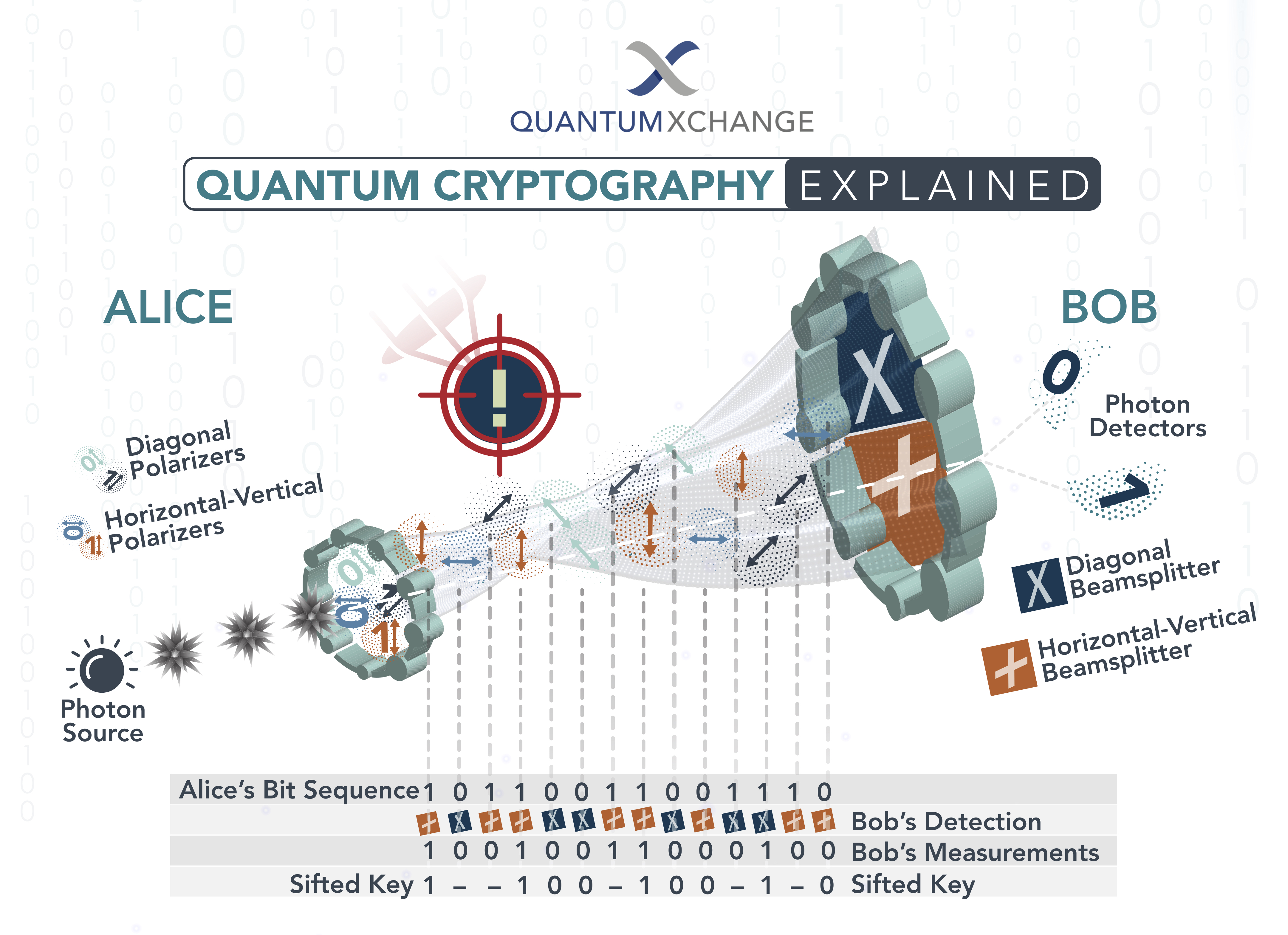
Post-Quantum Cryptography refers to cryptographic algorithms that are secure against attacks by quantum computers. Current public-key systems rely on mathematical problems (like integer factorization for RSA) that quantum computers can solve efficiently using algorithms like Shor's.
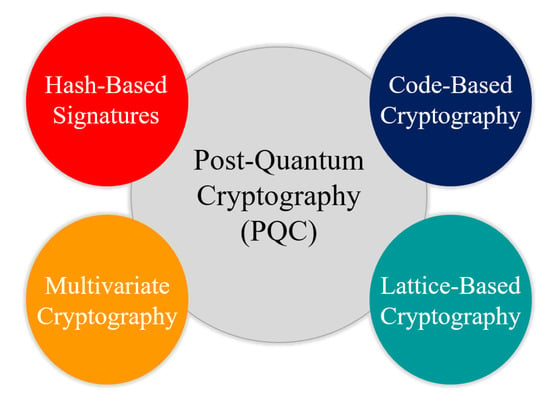
PQC algorithms are based on different hard problems that remain difficult even for quantum machines. These include lattice-based, hash-based, code-based, and others.
In the USA, NIST has led the global effort since 2016 to standardize these algorithms. By late 2025, the first standards are finalized, and migration is underway in federal agencies and private sectors.


Why Quantum Computing Threatens Current Encryption
Quantum computers use qubits and superposition to perform certain calculations exponentially faster than classical computers.
- Shor's Algorithm: Can factor large numbers and compute discrete logarithms quickly, breaking RSA, ECC, and Diffie-Hellman.
- Grover's Algorithm: Speeds up brute-force searches, weakening symmetric encryption (mitigated by larger key sizes, e.g., AES-256).
Experts estimate a cryptographically relevant quantum computer (CRQC) could arrive in 10-20 years, but data encrypted today could be vulnerable later. U.S. agencies like CISA and NSA emphasize immediate preparation.

Latest NIST PQC Standards (December 2025 Update)
NIST's multi-year process culminated in the release of the first standards in 2024, with ongoing developments:
- FIPS 203: ML-KEM (based on CRYSTALS-Kyber) – Primary for key encapsulation (general encryption, e.g., TLS).
- FIPS 204: ML-DSA (based on CRYSTALS-Dilithium) – Primary digital signature algorithm.
- FIPS 205: SLH-DSA (based on SPHINCS+) – Hash-based signature as a backup.
- FIPS 206 (in development): FN-DSA (based on FALCON) – Another signature option.
- HQC: Selected in March 2025 as a backup KEM (code-based, diversifying from lattice-based ML-KEM). Draft standard expected soon, finalization around 2027.
These standards provide diversity to hedge against future breakthroughs.


Types of Post-Quantum Algorithms
PQC candidates fall into several families:
- Lattice-Based (Most Prominent): ML-KEM, ML-DSA, FN-DSA. Based on problems like Learning With Errors (LWE) or Short Integer Solution (SIS). Efficient and versatile.
- Hash-Based: SLH-DSA. Extremely secure (relies only on hash functions) but larger signatures.
- Code-Based: HQC. Resistant for decades, good for diversification.
- Others: Multivariate or isogeny-based (less favored in current standards).
Lattice-based dominate due to performance, but backups like HQC add resilience.
Benefits and Challenges of PQC Migration
Benefits:
- Future-proof security against quantum threats.
- Compliance with U.S. mandates (e.g., CNSA 2.0, OMB guidelines targeting 2035 full migration).
- Protection from "Harvest Now, Decrypt Later" attacks.
- Hybrid modes for smooth transition.
Challenges:
- Larger key/signature sizes impact performance (especially IoT/embedded devices).
- Need for crypto-agility (systems that can swap algorithms easily).
- Inventory and testing overhead—NIST estimates larger scale than past transitions.
- Interoperability during hybrid phase.
In 2025, tools like OpenQuantumSafe and libraries (OpenSSL, Bouncy Castle) support PQC testing.
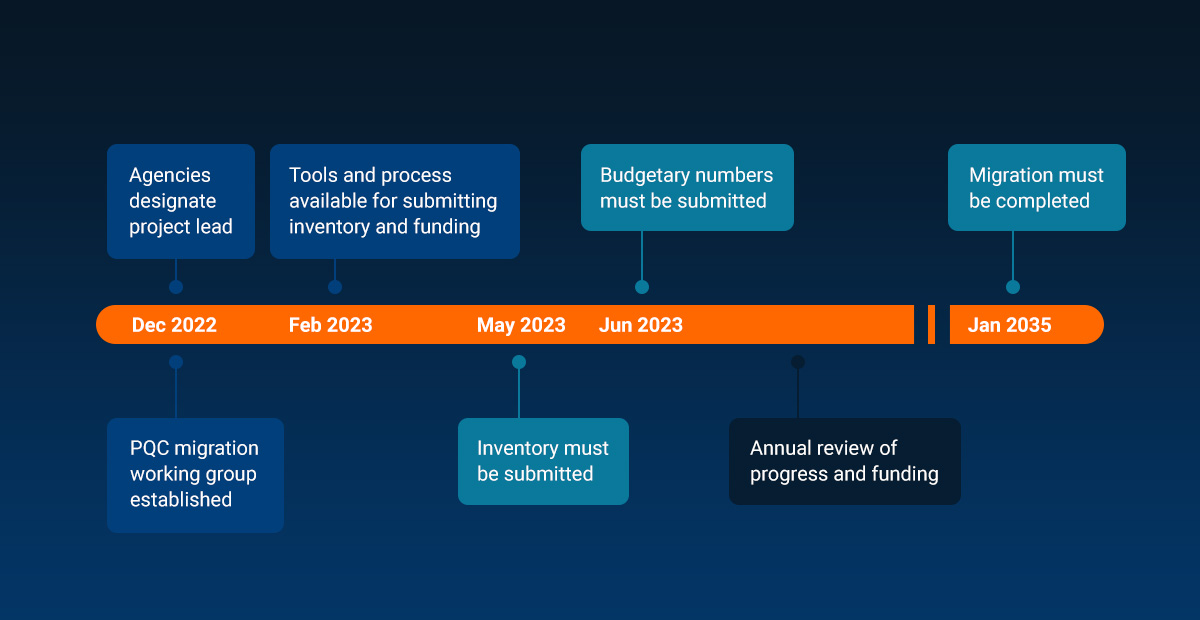
Step-by-Step PQC Migration Roadmap for USA Organizations
Follow NIST and CISA guidelines:
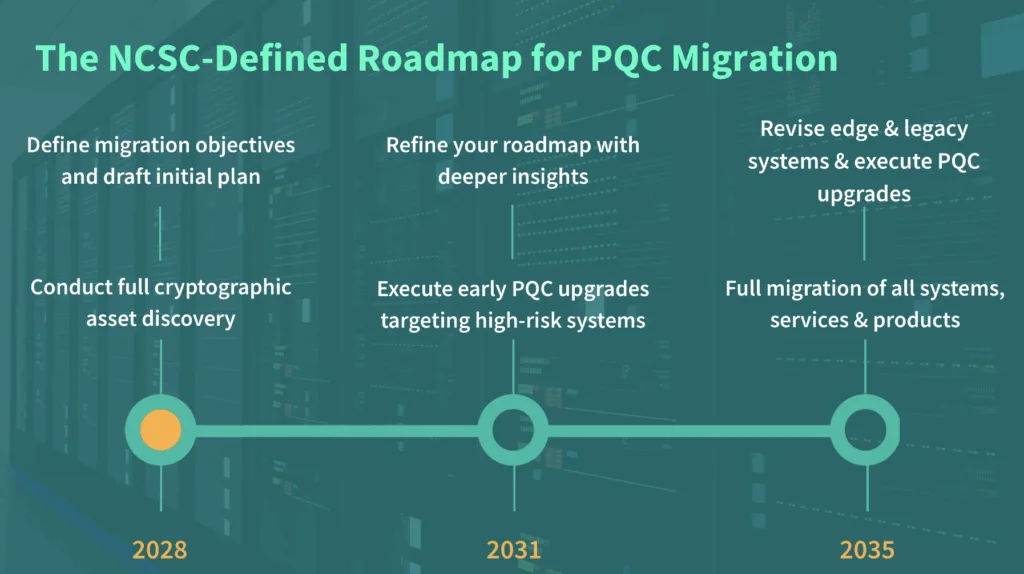
- Inventory (Now-2026): Identify all uses of vulnerable algorithms (RSA, ECC).
- Risk Assessment: Prioritize high-value data (e.g., financial, health records).
- Plan Hybrid Deployment: Use PQC + classical (e.g., ML-KEM + X25519).
- Test and Pilot: Implement in non-critical systems.
- Full Migration: Target 2030-2035 per federal timelines.
- Achieve Crypto-Agility: Design systems for easy algorithm updates.
Cloud providers like AWS, Azure, and Cloudflare are rolling out PQC support in 2025-2026.
2025-2026 Trends in the USA
- Increased adoption in federal systems (NSA CNSA 2.0 deadlines).
- Private sector push: Finance and tech leading (e.g., hybrid TLS).
- Market growth: PQC solutions projected to surge.
- Focus on crypto-agility tools and HSM upgrades.